
Insights
Training and Simulation
<p> <style type="text/css"><!--td {border: 1px solid #cccccc;}br {mso-data-placement:same-cell;}--> </style> Learn how the U.S. military is training a tech-savvy force of the future, taking advantage of developments in live, virtual, and constructive training to prepare troops for the battlefields of tomorrow.</p>
HPE/NVIDIA | Fast-track government AI deployment through AI factories
How government can rethink its approach to IT modernization

NASCIO 2026 Special Report
<p>Route Fifty reports from the organization’s annual conference in San Diego on the trends, concerns and future challenges facing state tech leaders.</p>
ServiceNow’s Blueprint for Agentic Government: The Executive Brief
<p>Agencies face rising demand, aging systems, and a retiring workforce, and hiring alone cannot close the gap. This executive brief explains how ServiceNow orchestrates AI across existing systems, turns policy changes into executable workflows, and governs every agent through one platform. The result is Autonomous, Human Government: services delivered, budgets respected, and public trust returned.</p>
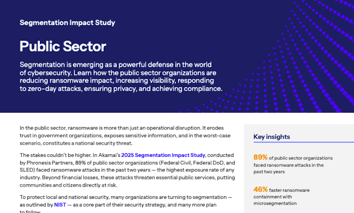
Akamai Segmentation Impact Study Public Sector
<p>With the rapid advent of AI, segmentation is a powerful cybersecurity defense. Learn how the public sector organizations are reducing ransomware impact, increasing visibility, responding to zero-day attacks, and achieving compliance.</p>
Akamai: Rethinking Zero Trust - Volume 1
<p>In volume 1 of this e-book series, explore CISA’s five-pillar zero trust model, identify where technology silos in the model can result in risk, and how to move beyond the pillars to a least permissive trust approach for comprehensive protection.</p>
JFrog Trusted Mission AI Whitepaper
<p>Federal agencies need binary-level supply chain governance for AI, including air-gapped networks. This JFrog whitepaper offers a 90-day roadmap to vault assets, block risky packages, and sustain cATO</p>
Be FedRAMP 20x-ready from day one with Vanta
<p>Selling to the federal government starts with FedRAMP, and the rules have changed. This guide shows how to get certified faster by automating paperwork, staying audit-ready, and reusing compliance work you've already done.</p>
[White Paper] Post-quantum transition: Two Clocks
<p>The complete guide to post-quantum cryptography transition. Learn regulatory deadlines, quantum threat timelines, exposure mechanisms, and the governance framework every enterprise needs.</p>
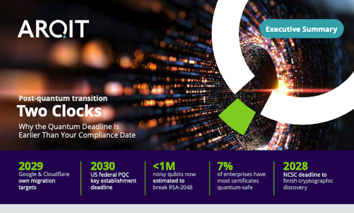
[Executive Summary] Post-quantum transition: Two Clocks
<p>Why your quantum deadline is earlier than you think. Discover the gap between regulatory 2030 and technical 2029 timelines and what boards need to act on now.</p>
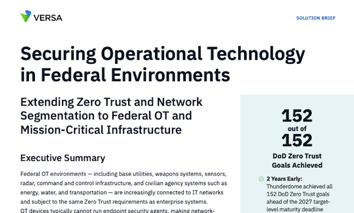
Securing Operational Technology in Federal Environments
<p>Extending Zero Trust and Network Segmentation to Federal OT and Mission-Critical Infrastructure</p>
Driving Cost Efficiency for Government Agencies
<p>Versa’s Secure Access Service Edge (SASE) platform supports your program to modernize your infrastructure by bringing networking and security together, driving meaningful savings and increased agility.</p>
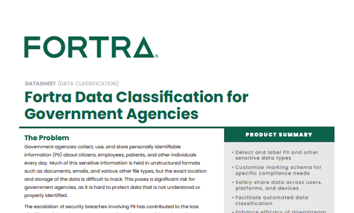
Datasheet: Fortra Data Classification for Government Agencies
<p>Sensitive data is hard to protect when agencies don’t know what they have. Download this guide to learn why Data Classification is foundational to identifying, prioritizing, and protecting information. Fortra is pursuing FedRAMP certification.</p>
Guide: The Definitive Guide to Data Classification
<p>Sensitive data is everywhere, but agencies can’t protect what they can’t see. Download to learn how Fortra Data Classification identifies, labels, and adds context to data so controls can act precisely. Fortra is pursuing FedRAMP certification.</p>
Stop Spinning Your Wheels: A CISO’s Roadmap for Turning Compliance into Operational Resilience
<p>Discover how compliance can serve as a roadmap to operational security, not a finish line, and how continuous monitoring turns compliance data into evidence of real resilience.</p>
From ATO Packages to Continuous ATOs
<p>Learn how RegScale can help you author SSPs, ingest STIG and scanner evidence, and manage POA&Ms in one place, so your AO sees control posture in real time and your program builds the foundation for cATO.</p>
Frost & Sullivan Best Practices for WAF and API Security
<p>Discover why Frost & Sullivan named Check Point the 2026 Global Technology Innovation Leadership winner for WAF and API Security. Learn how AI-driven WAAP protection helps stop zero-day threats, secure APIs, and reduce operational complexity.</p>
